
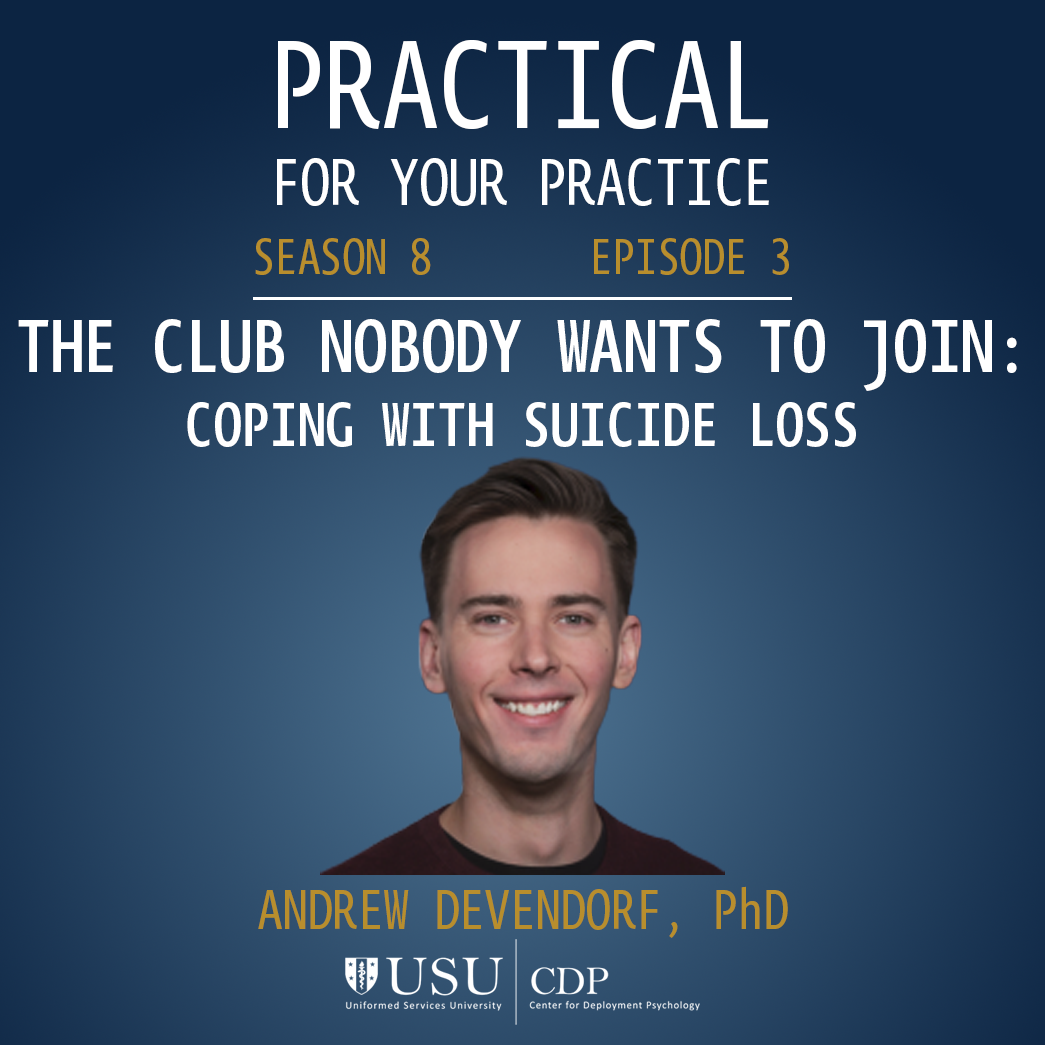
 Episode 3, Season 8: The Club Nobody Wants to Join: Coping with Suicide Loss
"What signs did I miss?” “Are people judging me?” “Should I even be in this field?” The suicide of a loved one triggers many thoughts and emotions in survivors. When the survivor is a mental health professional, those thoughts and emotions can be even more complicated, leading them to question their own skills and capabilities. On this episode we are joined by Dr. Andrew Devendorf, a psychologist who is also a survivor of suicide loss. He and Carin share their experiences in coping with the suicide of a loved one, how it impacted their professional lives, and how silencing the stigma can be. Our Actionable Intel provides resources for healing and connection.
Be sure to listen in and remember, we want to hear from you! Have thoughts about this episode? A “clinical sin” you’ve encountered? Ideas for future topics or guests? You can leave us a voice mail message at speakpipe.com/cdpp4p, or send us an email at cdp-podcast-ggg@usuhs.edu. As always, until next time, stay curious, and mind your EBPs.
 |
 |
 |
Show Notes:
Andrew Devendorf, Ph.D., is a Military Behavioral Health Psychologist with the Henry M. Jackson Foundation for the Advancement of Military Medicine. He serves as a subject matter expert in suicide prevention for the VA SAFEGUARD project.
Resources Mentioned in This Episode:
- American Foundation for Suicide Prevention: www.afsp.org
- National Alliance for Mental Illness: www.nami.org
- My Brother Went Missing, And The Search For Him Turned My World Upside Down, an article by Andrew Devendorf: https://www.huffpost.com/entry/missing-brother-search_n_5d67e1a5e4b063c341fc2782
- Surviving the Impossible: Reflections on Suicide Loss, an article by Andrew Devendorf: https://www.psychologytoday.com/us/blog/deeper-mental-health/202502/surviving-the-impossible-reflections-on-suicide-loss
- The Hilliest Course I’ve Ever Run, a blog by Carin Lefkowitz: https://deploymentpsych.org/blog/staff-perspective-hilliest-course-i%E2%80%99ve-ever-run-coping-suicide-loved-one
- An Afterword to “The Hilliest Course I’ve Ever Run,” a blog by Carin Lefkowitz: https://deploymentpsych.org/blog/staff-perspective-afterword-%E2%80%9C-hilliest-course-i%E2%80%99ve-ever-run%E2%80%9D
Calls-to-action:
- Keep the conversation going. If you’re a survivor or suicide loss, reach out to trusted friends, colleagues, or organizations. Don’t grieve alone. If you know a survivor, reach out to them.
- Share your impactful moment in the comments or via https://www.speakpipe.com/cdpp4p
- Subscribe to the Practical for Your Practice Podcast on the platform of your choice
- Subscribe to The Center for Deployment Psychology Monthly Email
This podcast is produced by the Consortium for Defense Psychology at the Uniformed Services University of the Health Sciences. The views expressed are those of the speakers and do not necessarily reflect the opinions of the Uniformed Services University, the Department of War, or the US Government. In addition, reference to any specific company, products, processes, or services does not necessarily constitute or imply endorsement by the Uniformed Services University, the Department of War, or the US Government.