
Welcome to CDP's Motivational Interviewing Resource Center
Motivational Interviewing Resource Center
These short videos feature Motivational Interviewing Trainers, Dr. Onna Brewer and Margo Bristow, LPC, discussing three key questions: What is MI? What is MI not? and How is MI learned?
| What is Motivational Interviewing? | What Motivational Interviewing is NOT | How is Motivational Interviewing Learned? |
 |
|
|
Continue your Motivational Interviewing Learning Journey with the Resources Below
- Motivational Interviewing: A Brief Guide
- MI Tip Cards
- Focusing in MI
- MI Demonstration & Learning Activities
- MI Learning Links
Motivational Interviewing is more than a set of techniques—it’s a way of being with people (Miller & Rollnick, 2023). At its core, MI is about curiosity, respect, and partnership; drawing out a person’s own motivations for behavior change rather than pushing them toward ours. This guide offers a concise overview of the key ideas, skills, and tasks that make MI effective. It is meant as both a reference and a practice companion, highlighting the spirit of MI alongside the technical skills that help conversations flow toward change growth.
What is Motivational Interviewing?
From William Miller and Stephen Rollnick’s book, Motivational Interviewing: Helping People Change and Grow, 4th Edition (2023):
“Motivational Interviewing (MI) is an evidence-based method for promoting change and growth.” (p. 3)
“MI is a particular way of talking with people about change and growth to strengthen their own motivation and commitment.” (p. 3)
“You are in an interaction, a dance, and not a solo performance. Respond in the moment rather than following a rehearsed routine, checklist, or manual, and be mindful of your own reactions.” (p. 6)
The Spirit of MI
“The curious paradox is that when I accept myself just as I am, then I change.” -Carl Rogers
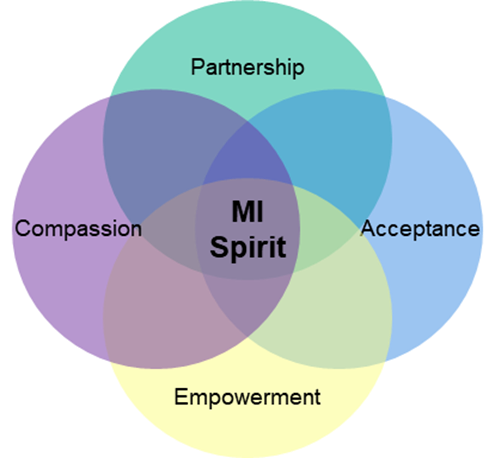
The Spirit of Motivational Interviewing is the foundation of the “relational” component of MI, and it includes four capacities or values that the MI practitioner seeks to embody with and for their clients - acceptance, partnership, compassion, and empowerment.
Acceptance - MI practitioners offer unconditional positive regard by emphasizing:
- Absolute worth - every person has inherent value, unconditionally.
- Autonomy - every person has an irrevocable right and capacity for self-direction.
- Accurate empathy - every person has their own inner world that I want to try to see as if it were my own, knowing that my understanding will always be limited.
- Affirmation - every person has strengths and makes efforts worthy of admiration.
Partnership - MI is done “for” and “with” a person. MI practitioners let go of the assumption we are supposed to have and provide all the answers. MI is an active collaboration between two experts; MI practitioners may be experts in behavior change or various resources in the world; the people we talk with are the experts on their own lives.
Compassion - MI practitioners seek to promote other’s welfare, reduce suffering and help people live healthier, more meaningful lives, and to give priority to the needs of others. MI is not a way of tricking people into changing; it is a way of activating their own motivation and resources for change. We evoke change talk toward goals that serve the client’s best interest, not our own; we remain neutral when a compassionate target behavior is unclear.
Empowerment - MI practitioners are not possessive nor are we passive about helping people make healthy changes in their lives; we are here as guides or coaches, somewhere between directing and following. People already have within them much of what is needed, and our task is to evoke it, to call it forth. In MI, we seek to empower others to connect with their own values, desires, and abilities for change and growth. The implicit message: “You have what you need, and together we will find it.”
Ambivalence and Change Talk
"People are generally better persuaded by the reasons which they have themselves discovered than by those which have come into the mind of others." -Pascal (Pensées, 1670)
Deconstructing “Resistance”: MI breaks down what has been referred to as “resistance” into two, more functional parts: sustain talk, which communicates ambivalence about behavior change, and discord, which communicates mistrust or disruptions in the relationship between the client and you. Embracing the Spirit of MI, especially emphasizing acceptance and autonomy, can help “re-pair” discord in the relationship. We largely sidestep sustain talk by letting it be, or actively soften it through particular styles of complex reflections (see below). And because ambivalence is normal and people are accepted unconditionally in MI, we end conversations on a positive note, no matter what the person has decided. In most cases, if discord is defused, we are making a meaningful connection with a person who will likely return to talk more, and perhaps nurturing their own internal seed for making helpful changes in their life.
Change Talk - Listen for it, Reflect it, Ask for it, and Reinforce it. “Change talk” and “sustain talk” are conceptually opposite—the person’s arguments for and against change. Preparatory change talk (e.g., desires, abilities, reasons, and needs - DARN) tends to precede mobilizing change talk (e.g., commitment, activation, and taking steps - CAT). MI involves evoking and strengthening change talk by listening for it, reflecting it back, asking for it (e.g., “What makes this important to you? How might your life be different or better for you if you were to decide to…? What might need to happen to help you get there?”), and reinforcing it. Change talk can be clear language related to a specific behavior and it might also relate to the client’s deeper personal values and areas of their life where they’d like to grow and live more fully; skillful MI involves listening for and evoking all depths of change talk and exploring people’s values in the service of change and growth.
The Four Tasks of MI
MI is a form of guiding, which falls somewhere between following and directing, and may occur in a series of recursive processes. In each task, there’s an unspoken, metaphorical, question we are posing to the person we wish to help.
Engaging – Building partnership, a helpful connection and working relationship. It is a prerequisite for everything that follows, and we are never “done” engaging. The unspoken question: “May we travel together?”
Focusing – Collaboratively developing and maintaining a specific direction in the conversation about a particular behavior change. The unspoken question: “Where are we going?”
Evoking – The “heart” of MI; eliciting the person’s own motivations and arguments for change. In this task, the question is actually spoken: “What makes this journey important to you?”
Planning – When people’s motivation reaches a threshold of readiness, the balance tips and they begin thinking and talking more about when and how to change and less about whether and why. The questions: “How will you get there, and how can I be helpful?”
The Core Communication Skills of MI - O.A.R.S.
Open-ended questions invite elaboration. They can begin with “Tell me about…”, “What do you think…?”, “How do you feel about…?”, etc. Open questions can also evoke change talk (e.g., “What makes this important to you?”).
Affirming is making a statement showing genuine appreciation of a person’s specific positive actions or good efforts (simple affirmation), or their deeper positive qualities, strengths, or personal values (complex affirmation). Affirmations often begin with “You are…”, “You did…”, “You were able to…” and are distinct from statements of praise (“I am so proud of you.”) or cheerleading (“You can do it!”). We can ask about personal valued areas of our client’s lives or the past to help us listen for qualities to affirm, for example, “Tell me about a time when you got through a difficult time like this…”
Reflecting: Rooted in the knowledge that 1) we tend to believe what we hear ourselves say, and 2) a well-formed reflection is less likely to evoke defensiveness and more likely to invite elaboration compared with a question. Reflections are statements, not questions, that we offer back to a person based on what they have said and what we are trying to understand about their experience and motivations. Aim for a 2:1 ratio of reflections to questions such that most of what you offer in a conversation are reflections. They take two primary forms: ●
- Simple reflections - paraphrase or briefly restate a select client statement or feeling (“You feel/think…”), reflect change talk that comes from the client (“You want/need/are ready to…”). Sample client statement: “I’m not sure I want to change my drinking.” Simple reflection: “You’re uncertain about it.”
● Complex reflections - deeper, go beyond what is said and may guess at meaning, evoke change talk, or soften sustain talk. They include feeling/emotion reflections (“You’re feeling…”), amplified/overstating (“You strongly feel…”), understating (“You feel a little…”), double-sided reflections ending on change talk (“You want...and at the same time you also want…”), analogies (“You’re between a rock and a hard place with this…”), and continuing the paragraph (“And you also would like to see something change with…”). Sample client statement: “I’m not sure I want to change my drinking.” Feeling/emotion reflection: “You’re feeling confused about the situation.” Amplified/overstate reflection: “Your drinking really doesn’t feel like it’s causing any problems for you right now.” Understate reflection: “You’re a bit uncertain about what you want to do.” Double-sided reflection: “Part of you wants to continue drinking the way you have been, and part of you wants to drink less.” Analogy: “You’re feeling stuck between a rock and a hard place.” Continuing the paragraph: “And you’re seeking some clarity about what you want to do.”
Summarizing: Summaries in MI include special forms of collective reflection to reinforce change talk by offering a bouquet of flowers of what the client has said about their desires, abilities, reasons, and needs (DARN) toward a particular change. Summaries can also help make transitions between the tasks of MI, when the time is right.
Offering Information and Advice in MI - the AOA skill
The Core Communication Skills of MI - O.A.R.S. Consistent with the Spirit of MI, when it feels appropriate and helpful to offer information and advice, we can use the AOA skill to help us limit and tailor our information and advice-giving for the client and to foster a collaborative exchange.
Ask: what they already know or gaps in knowledge; simply reflect their response, without judgment; then ask for permission to give information or recommendations (e.g., “What do you already know about…?”; “Can I share some things that have been helpful for others in my experience?”).
Offer: clear, brief, and specific information or advice and include a statement that emphasizes their autonomy to do what they want with the information or recommendation (e.g., “It is completely up to you what you do with this information.”)
Ask: ask for their personal reactions to the information offered (e.g., “What do you think about that for you?”) and reflect, reflect, reflect, especially any change talk.
Learning MI
“There is no teaching; only learning.” -Monty Roberts
Miller & Rollnick (2013) reviewed the studies on MI training outcomes and found that that after an initial training of at least 10 hours:
- Learners show a spike in some MI-consistent skills, e.g., reflections.
- Without follow up, skills return to baseline after 4 months.
- Learners show no significant decrease in MI-inconsistent behavior (e.g., roadblocks to listening like over-questioning, labeling, confronting)
- Adding individual skills feedback and/or coaching for each learner significantly helps with MI adoption, growth in skills, and sustainability across an organization (for example, trainers listening to real MI practice recordings and providing standardized coded feedback with the MITI tool).
“The 9 Tasks of Learning MI” (Miller & Moyers, 2006; Rosengren, 2017)
- Embracing and conveying the Spirit of MI
- Understanding and working the Four Processes/Tasks
- Using and being intentional with OARS and AOA
- Recognizing & reinforcing Change Talk
- Eliciting & strengthening Change Talk
- Dancing with and moving past Sustain Talk & discord
- Developing and revising a change plan
- Consolidating and re-engaging client commitment
- Shifting into and out of MI and other approaches
Some Recommended Readings
Mentha, H. (2020). Someone Good To Talk To: Reflections on Motivational Interviewing in Practice. Self Published. https://www.amazon.com/Someone-Good-Talk-Motivational-Interviewing/dp/06...
Miller, W. R. & Moyers, T. B. (2006). Eight stages in learning Motivational Interviewing. Journal of Teaching in the Addictions, 5(1), 3-17.
Miller, W. R. & Moyers, T. B. (2021). Effective psychotherapists: Clinical skills that improve client outcomes. Guilford Press.
Miller, W. R. & Rollnick, S. (2023). Motivational Interviewing: Helping people change and grow, Fourth Edition. Guilford Press.
Rollnick, S., Miller, W. R., & Butler, C. C. (2022). Motivational Interviewing in Health Care: Helping Patients Change Behavior, Second Edition. Guilford Press.
Rosengren, D. B. (2017). Building Motivational Interviewing skills: A practitioner workbook, Second Edition. Guilford Press.
Wagner, C. C. & Ingersoll, K. S. (2013). Motivational Interviewing in Groups. Guilford Press.
A quick, practical set of Motivational Interviewing Tip Cards highlighting core MI components and skills to support everyday practice.
“At any point in the conversation, it can be helpful to step back and clarify or renegotiate what
the agreed direction of travel might be.”
-Stephen Rollnick
In Motivational Interviewing, the Focusing task is not about choosing the “right” topic for someone—it’s about collaborating to decide together where attention might be most helpful. Traditional agenda setting often feels provider-driven: the clinician sets the direction, the client responds. Agenda mapping shifts this toward partnership, emphasizing autonomy and curiosity. Rather than narrowing too quickly, we pause to explore what matters most to the person sitting with us.
From “agenda-setting” to “agenda mapping”
Agenda mapping involves genuinely seeking collaboration and asking permission before moving into topics for change. When there are multiple areas on the table, a simple tool like a large “bubble sheet” can help map out possibilities. Each bubble represents a topic—health, stress, relationships, habits, alcohol use—whatever is on the client’s mind and where there might be some ambivalence. The process is navigated with OARS (open questions, affirmations, reflections, summaries) and grounded in the Spirit of MI.
Sample Guiding Questions
- “How can we make this time most helpful for you?”
- “What areas of your life are on your mind right now?”
- “If you like, we can use this sheet to help us map out some possible topics to focus on together.”
- “Can we talk a bit more about [specific topic]?”
Prioritizing Together
Once several possible areas are mapped, the client can circle or mark the ones that feel most important. Using a smaller bubble sheet allows us to break down larger topics into sub-topics—each with potential strands of change talk to explore. This “emerging agenda” keeps the process flexible and dynamic.
Moving Toward Evoking
Agenda mapping is not the end point—it is the bridge into evoking. By identifying and prioritizing topics together, we set the stage for conversations that honor autonomy and strengthen motivation.
“Engagement is fundamental.
Without engagement, the collaborative essence of focusing is lost.”
-Nina Gobat, 2014
This MI demonstration video comes with optional activities that can enhance your learning and practice.
Video Activities:
Here is a collection of activities to accompany this MI demonstration video. Take a look - it’s your choice how you’d like to engage with the material for your MI learning.
Before watching the video, you might print this transcript of the video where you’ll find several activities that can help deepen your understanding of MI. Feel free to complete any or all of these activities as you watch or re-watch the video:
- Highlight/underline the client’s change talk and circle the sustain talk.
- Identify the OARS skill (open-ended questions, affirmations (simple or complex), reflections (simple or complex), and summaries) as you hear the interviewer use them throughout the video.
- Mark where you notice the 4 Tasks of MI seem to begin and transition: Engaging, Focusing, Evoking & Planning.
- Here is the coded transcript of the video with the items above identified.
After watching the video, you might:
- Compare your responses on the transcript activities to the coded transcript
- Answer MI Video Thought Questions
- Answer multiple choice MI Video Knowledge Check Questions
MI Video Thought Questions:
1. In what ways did the interviewer in the video convey the MI Spirit?
2. How did the interviewer strive for and convey accurate empathy during the conversation? Where did the interviewer misinterpret something the client said so the client repeated themselves? How did the interviewer modify her next reflection to try again?
3. When it comes to moving throughout the 4 Tasks of MI, what makes each transition point happen and when in this conversation? What was happening with the client and the interaction that may have indicated to the interviewer that it was a good moment to transition to another task? How did the interviewer make those transitions? How did the client respond?
4. What do you notice about the proportion of sustain talk and change talk from the client and how it changed across the conversation? What did the interviewer do that cultivated change talk and/or softened the sustain talk? (Hint, see if you can find the double-sided and continuing the paragraph reflections ending on change talk.)
5. What feedback might help the interviewer grow and strengthen their MI skills? Where did you hear opportunities for improving person-centered listening skills (e.g., allowing more pauses and silence, interrupting less, offering briefer reflections with less complexity, and fewer summaries) and evoking skills (e.g., less emphasis on sustain talk, offering more affirmations).
MI Video Knowledge Check Questions:
Some of the questions are specific to the demo video, while others are not. When you check your answers in the key at the end, consider why you chose your responses and what makes the correct answer correct. You may find this MI Brief Guide helpful.
1. This statement by the Interviewer (transcript line 7), “It sounds like you've had some tricky days lately. Well, what would be helpful for us to talk about?” is most consistent with which of the 4 Tasks of MI?
a. Engaging
b. Focusing
c. Evoking
d. Planning
2. The interaction below is most consistent with which of the 4 Tasks of MI?
a. Engaging
b. Focusing
c. Evoking
d. Both Focusing & Evoking
3. Which of the following are the major components of the MI Spirit?
a. Partnership, Acceptance, Compassion, Engagement
b. Planning, Allowing, Compassion, Empowerment
c. Compassion, Acceptance, Partnership, Empowerment
d. Caring, Affirming, Participating, Empowerment
4. Comparing the interviewer’s reflection in line 25 with their next reflection in line 27. Which skill of MI is better demonstrated in line 27?
a. accurate empathy
b. reflective empathy
c. relative empathy
d. compassionate empathy
5. The Interviewer statement (line 23), “And it really is up to you, if…You're the only one who can kind of define that line.” is an example of what type of skill in MI?
a. emphasizing autonomy
b. asking permission
c. simple reflection
d. affirmation
6. In Motivational Interviewing, DARN stands for:
a. Detect, Affirm, Reflect, Notify
b. Desires, Abilities, Reasons, Needs
c. Demands, Abilities, Readiness, Noticing
d. Desires, Affirmations, Readiness, Needs
7. The Interviewer statement (line 27), “And you want to hold a… a good reputation in your work for being dedicated, for being the hard worker. That was also reinforced in the military. And a part of you wants to be free from worrying about all day outside of work, what people are thinking, too.” is an example of what type of reflection in MI?
a. simple reflection
b. amplified reflection
c. continuing the paragraph reflection
d. clarifying reflection
8. In MI terms, the client statement (line 38), “I think for me, I would want it to look like, you know, I can step away from work and, uh, not think about it at all. That's how...not to even, um you know, have a thought about, hey, I got this task to do or anything like that. Kind of how I feel when I'm on leave.” is an example of:
a. commitment language
b. change talk
c. sustain talk
d. resistance
Answer key:
1.a,
2.d,
3.c,
4.a,
5.a,
6.b,
7.c,
8.b
MI Instructional Videos
- Motivational Interviewing by Psychwire - playlist of 11 brief didactic videos: https://youtube.com/playlist?list=PLffBXI4nwQ4gdfX3L2nIoziobaRdwCWSy&si=hNrU9fo9NPSJCQWE
- "Bill Miller - On Change Talk” (MI in Leadership and Organizations, 11 min): https://www.youtube.com/watch?v=YIhMsTdZMVM
MI Demonstration Videos
- “Motivational Interviewing with Survivors of Intimate Partner Violence: Session 1 of 3” (Denise Ernst MI demonstration, 23 min): https://youtu.be/P3JUXQ4kkHs?si=KvDnGvS2Zj_qyyOQ
- “Motivational interviewing in brief consultations | BMJ Learning” (Stephen Rollnick with a client expressing discord and links to a free MI BMJ Learning course, 7 min): https://youtu.be/bTRRNWrwRCo?si=9Hro4js17XEsX4Su
- “The Silent Man MI CC” (Bill Miller with a low verbal client, 9 min): https://youtu.be/hHIdb6vuh-c?si=rJdft75Tgd-g7dGZ
- “The Rounder” (Terri Moyers with a mandated client, but this YouTube video might not have appropriate permissions, 16 min): https://youtu.be/b8C1jQe0FZE?si=R5y2qluVZqP641XU
MI Reading List & References
MI Values Card Sorts (a helpful tool for structured values exploration; Miller & Rollnick, 2023, p. 163-167)
- Original (2001) values cards for printing/cutting out with three response options
- Newer 2011 version with more response options and instructions
- Online versions: |
○ https://www.valuescardsort.com/
○ https://sakai.ohsu.edu/access/content/group/Kathlynn_Tutorials/public/Value%20Card%20Sort%20Exercise%20-%20Storyline%20output/story_html5.html
○ https://www.think2perform.com/values/
MI Trainers
These professionals can provide quality MI training workshops, skills coaching, fidelity monitoring, and additional resources for MI learning, dissemination, and organizational implementation:
- Brewer & Bristow Training / Onna Brewer, PhD (onna@brewerbristow.com) & Margo Bristow, LPC (margo@brewerbristow.com)
- Motivational Interviewing Network of Trainers