
Staff Perspective: Addressing the Silent Threat of Poor Sleep for Service Members

We all know that sleep is important. A 2021 congressional report by the Department of Defense (DOD) described sleep as the most important biological factor determining health and combat readiness. The report was based on a study required by the National Defense Authorization Act (NDAA) for Fiscal Year 2020 (Public Law 116-92).
The study had four objectives:
- Provide a standardized definition of sleep deprivation.
- Conduct an assessment of the prevalence of sleep deprivation among members of the Armed Forces.
- Assess the relationship between sleep deprivation and medical conditions such as traumatic brain injury (TBI), post-traumatic stress disorder (PTSD), and depression.
- Provide recommendations on efforts to mitigate sleep deprivation based on the study's findings.
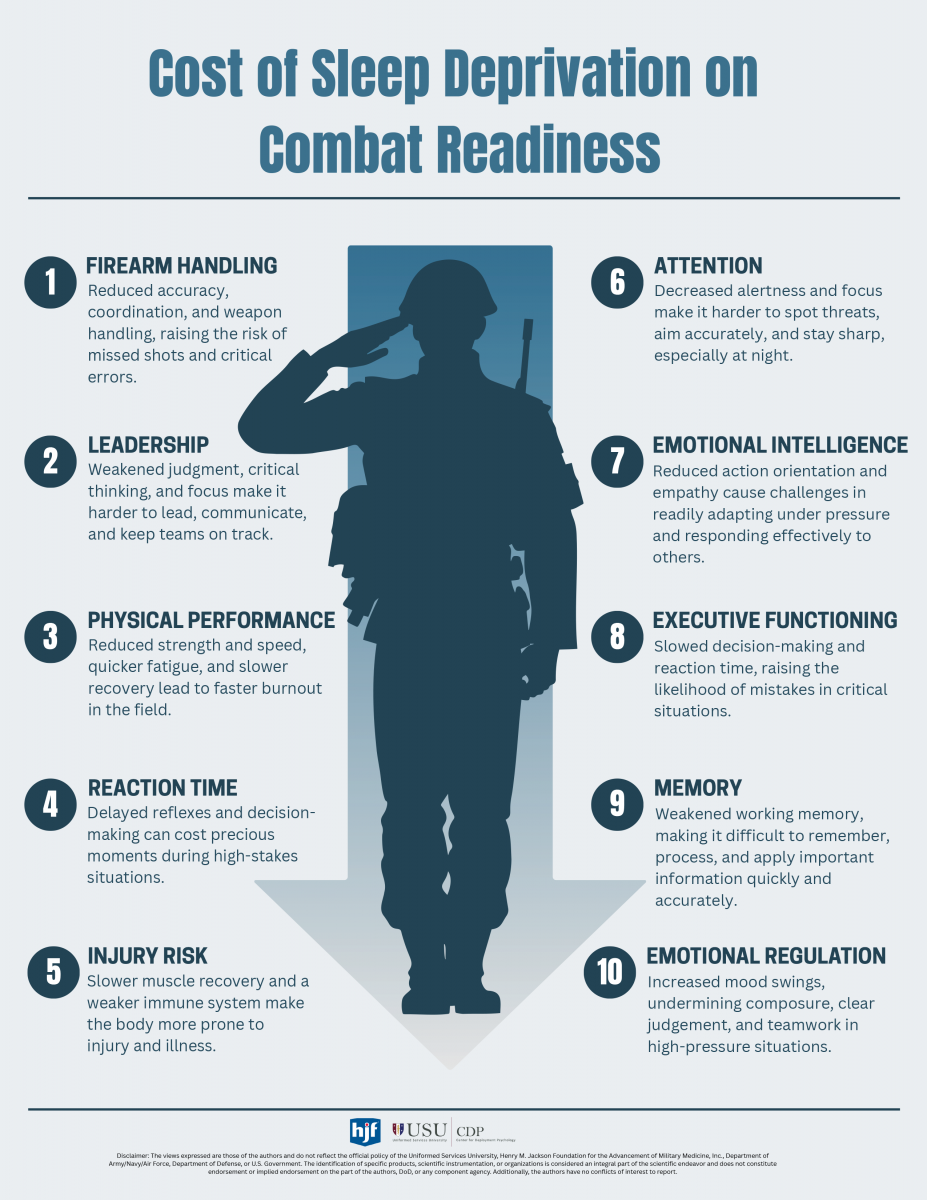 The report defines sleep deprivation as “inadequate sleep that negatively impacts a service member’s military effectiveness, evidenced by a reduced ability to execute complex cognitive tasks, communicate effectively, quickly make appropriate decisions, maintain vigilance, and sustain a level of alertness required to carry out assigned duties” (Department of Defense, 2021). A recent review by Rodden et al. (2026) on the impact of sleep deprivation on combat readiness supports the DoD’s definition and created an infographic to summarize key findings from the literature (See figure 1). Prevalence estimates for sleep deprivation among service members were roughly twice as high compared to civilian populations, with 64% reporting getting less than seven hours of sleep per night.
The report notes multiple challenges to obtaining adequate sleep, often related to operational demands. It provides supporting evidence that sleep deprivation is significantly related to mental health conditions such as TBI, PTSD, depression, as well as suicide risk, with 23% of deployed service members screening positive for a mental health disorder when getting four or less hours of sleep per night (Department of Defense, 2021). To address these findings, the report made several recommendations, including adopting duty schedules that ensure eight hours of sleep, implementing sleep-related training for both service members and leadership, the importance of brief interventions, research focused on circadian rhythm issues, and establishing a clearinghouse for military sleep-related resources.
However, a Government Accountability Office (GAO) report in 2024 found that the DoD had no formal plans to implement or monitor the recommendations from that 2021 study. The GAO report noted that between 2015 and 2019, there were 489 reported instances of fatigued-driving related fatalities. Additionally, fatigue has contributed to hundreds of millions of dollars in damage to ships, vehicles, and aircraft (Government Accountability Office, 2024).
Citing the need to address military culture factors that negatively affect sleep and to improve the coordination of research and training, the GAO report serves as a call to action to convene a summit that focuses on addressing sleep and fatigue issues within the Department of War. The Uniformed Services University and its Center for Deployment Psychology, Consortium for Health and Military Performance, Center for the Study of Traumatic Stress, Department of Neurology and Rehabilitative Medicine, along with the Walter Reed Army Institute of Research, and United States Air Force are hosting a 2-day summit for researchers, policy makers, and other key stakeholders to address:
- Sleep and fatigue challenges in military operations
- The role of research in advancing sleep intel to support mission readiness
- Dissemination and implementation strategies to optimize sleep and fatigue management
For more information about the sleep summit, please contact dod-sleep-summit-ggg@usuhs.edu or visit https://sites.google.com/usuhs.edu/sleep-and-fatigue-management/home
The opinions in CDP Staff Perspective blogs are solely those of the author and do not necessarily reflect the opinion of the Uniformed Services University of the Health Science or the Department of Defense.
Timothy Rogers, Ph.D., is an Assistant Director of Online Training, Technology and Telehealth for the Center for Deployment Psychology (CDP) at the Uniformed Services University for the Health Sciences in Bethesda, Maryland.
References:
Department of Defense (2021). Study on the effects of sleep deprivation on the readiness of members of the Armed Forces.
https://assets.documentcloud.org/documents/20495233/study-on-effects-of-sleep- deprivation-on-readiness-of-members-of-the-armed-forces-final-report.pdf
Government Accountability Office. (2024) Military readiness: Comprehensive approach needed to address service member fatigue and mange related efforts. (Report No. GAO-24-105917). https://www.gao.gov/products/gao-24-105917
Rodden, J., Rogers, T., Dolan, D., & Paxton Willing, M. M. (2026). Sleep isn’t Optional, it’s
Operational: The biopsychosocial toll of sleep deprivation in the armed
forces [Manuscript accepted]. Military Medicine.


We all know that sleep is important. A 2021 congressional report by the Department of Defense (DOD) described sleep as the most important biological factor determining health and combat readiness. The report was based on a study required by the National Defense Authorization Act (NDAA) for Fiscal Year 2020 (Public Law 116-92).
The study had four objectives:
- Provide a standardized definition of sleep deprivation.
- Conduct an assessment of the prevalence of sleep deprivation among members of the Armed Forces.
- Assess the relationship between sleep deprivation and medical conditions such as traumatic brain injury (TBI), post-traumatic stress disorder (PTSD), and depression.
- Provide recommendations on efforts to mitigate sleep deprivation based on the study's findings.
The report defines sleep deprivation as “inadequate sleep that negatively impacts a service member’s military effectiveness, evidenced by a reduced ability to execute complex cognitive tasks, communicate effectively, quickly make appropriate decisions, maintain vigilance, and sustain a level of alertness required to carry out assigned duties” (Department of Defense, 2021). A recent review by Rodden et al. (2026) on the impact of sleep deprivation on combat readiness supports the DoD’s definition and created an infographic to summarize key findings from the literature (See figure 1). Prevalence estimates for sleep deprivation among service members were roughly twice as high compared to civilian populations, with 64% reporting getting less than seven hours of sleep per night.
The report notes multiple challenges to obtaining adequate sleep, often related to operational demands. It provides supporting evidence that sleep deprivation is significantly related to mental health conditions such as TBI, PTSD, depression, as well as suicide risk, with 23% of deployed service members screening positive for a mental health disorder when getting four or less hours of sleep per night (Department of Defense, 2021). To address these findings, the report made several recommendations, including adopting duty schedules that ensure eight hours of sleep, implementing sleep-related training for both service members and leadership, the importance of brief interventions, research focused on circadian rhythm issues, and establishing a clearinghouse for military sleep-related resources.
However, a Government Accountability Office (GAO) report in 2024 found that the DoD had no formal plans to implement or monitor the recommendations from that 2021 study. The GAO report noted that between 2015 and 2019, there were 489 reported instances of fatigued-driving related fatalities. Additionally, fatigue has contributed to hundreds of millions of dollars in damage to ships, vehicles, and aircraft (Government Accountability Office, 2024).
Citing the need to address military culture factors that negatively affect sleep and to improve the coordination of research and training, the GAO report serves as a call to action to convene a summit that focuses on addressing sleep and fatigue issues within the Department of War. The Uniformed Services University and its Center for Deployment Psychology, Consortium for Health and Military Performance, Center for the Study of Traumatic Stress, Department of Neurology and Rehabilitative Medicine, along with the Walter Reed Army Institute of Research, and United States Air Force are hosting a 2-day summit for researchers, policy makers, and other key stakeholders to address:
- Sleep and fatigue challenges in military operations
- The role of research in advancing sleep intel to support mission readiness
- Dissemination and implementation strategies to optimize sleep and fatigue management
For more information about the sleep summit, please contact dod-sleep-summit-ggg@usuhs.edu or visit https://sites.google.com/usuhs.edu/sleep-and-fatigue-management/home
The opinions in CDP Staff Perspective blogs are solely those of the author and do not necessarily reflect the opinion of the Uniformed Services University of the Health Science or the Department of Defense.
Timothy Rogers, Ph.D., is an Assistant Director of Online Training, Technology and Telehealth for the Center for Deployment Psychology (CDP) at the Uniformed Services University for the Health Sciences in Bethesda, Maryland.
References:
Department of Defense (2021). Study on the effects of sleep deprivation on the readiness of members of the Armed Forces.
https://assets.documentcloud.org/documents/20495233/study-on-effects-of-sleep- deprivation-on-readiness-of-members-of-the-armed-forces-final-report.pdf
Government Accountability Office. (2024) Military readiness: Comprehensive approach needed to address service member fatigue and mange related efforts. (Report No. GAO-24-105917). https://www.gao.gov/products/gao-24-105917
Rodden, J., Rogers, T., Dolan, D., & Paxton Willing, M. M. (2026). Sleep isn’t Optional, it’s
Operational: The biopsychosocial toll of sleep deprivation in the armed
forces [Manuscript accepted]. Military Medicine.