
Staff Perspective: Micro-Resilience – Small Daily Habits That Strengthen Mental Wellness

In military culture, resilience is often framed as endurance — pushing through, carrying on, not slowing down. Strength is measured by how much stress an individual can shoulder without falling apart.
However, stress can become chronic through prolonged work hours, unpredictable schedules, frequent changes, separations from support systems, or exposure to perceived or real threats that keep the nervous system activated for extended periods. This can lead to exhaustion, irritability, sleep disruption, poor communication, and emotional numbing, and eventually a shame spiral for not practicing better self-care. The real challenge is to create opportunities to downshift because the nervous system can better handle chronic stress when it also receives signals of safety and regulation.
Resilience doesn’t require special equipment, extended time off, or perfect conditions — it needs to be practiced daily in small doses through repeatable habits that help the nervous system recover from stress. This is where micro-resilience becomes a clinical tool. Micro-resilience refers to brief, intentional actions that help regulate the stress response throughout the day. Individually, these actions may feel insignificant. Collectively, they create physiological conditions that support emotional regulation, cognitive flexibility, and relational capacity. Think of these strategies as a replenishment tool, like a protein shake after completing a challenging workout. Clients can create a routine that includes many mini-opportunities for recovery for their nervous system.
Framing resilience this way can help reduce all-or-nothing thinking and support clients who feel overwhelmed by traditional self-care recommendations. Clinically, micro-resilience aligns well with trauma-informed and strengths-based approaches.
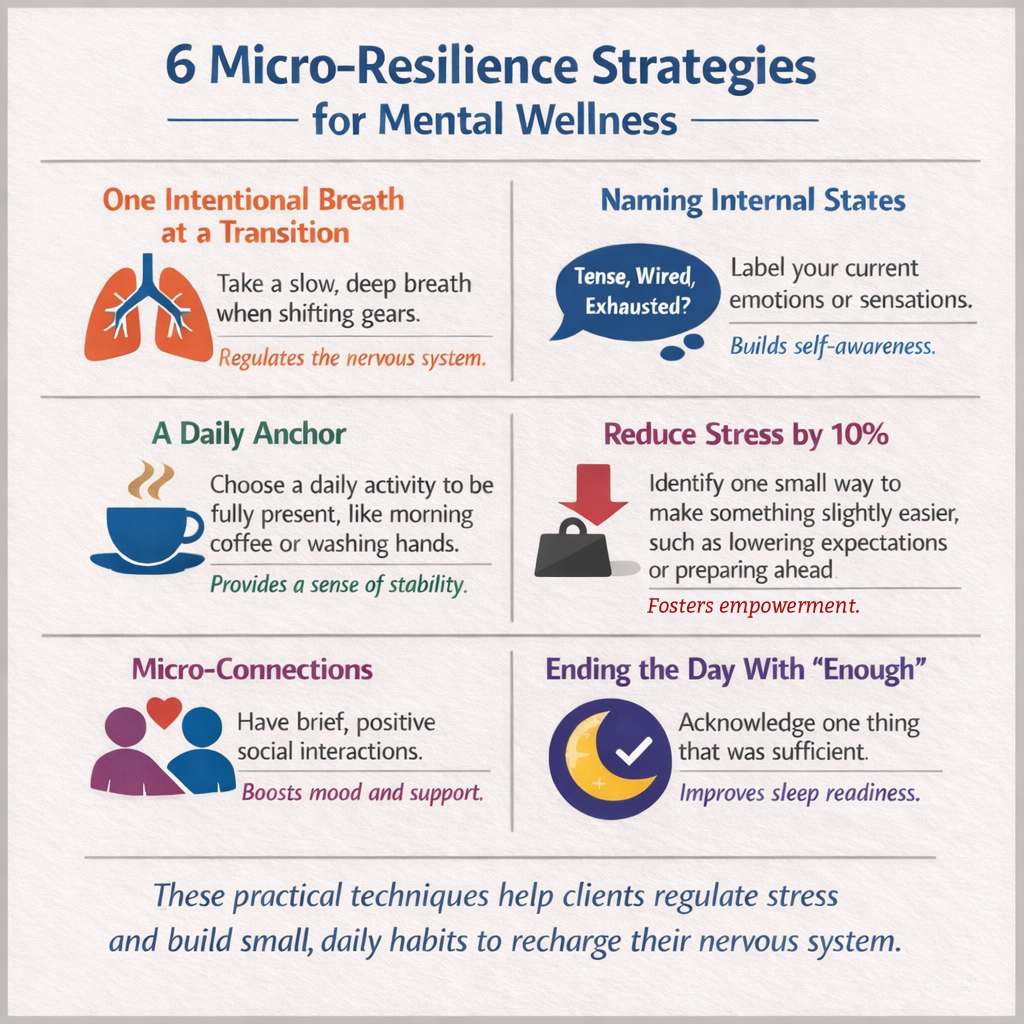
Micro-resilience strategies are designed to be taught simply and adapted to each client’s individual experience. Providers may find it helpful to offer one or two at a time, and normalize experimenting rather than compliance. The graphic provides examples of six micro-resilience strategies to share with clients.
In families, micro-resilience can be framed as a shared practice, rather than an individual responsibility. This approach reduces pressure on any one family member to “hold it together.” Family-based examples, include:
- Consistent goodbye or reunion rituals
- Naming stress out loud
- One shared moment of calm
Micro-resilience reminds us, and our clients, that meaningful change doesn’t require ideal conditions. It only requires enough moments of safety, connection, and regulation to allow the nervous system to rest.
If you want to further explore the topic of micro-resilience, consider listening to this podcast episode with Bonnie St. John, co-author of Micro-Resilience: Minor Shifts for Major Boosts in Focus, Drive, and Energy, https://www.youtube.com/watch?v=fnMcNQ5mBhc.
The opinions in CDP Staff Perspective blogs are solely those of the author and do not necessarily reflect the opinion of the Uniformed Services University of the Health Science or the Department of Defense.
Annie Layden, LICSW, is a licensed clinical social worker working as a Military Behavioral Health Social Worker for the Center for Deployment Psychology at the Uniformed Services University of the Health Sciences in Bethesda, Maryland.


In military culture, resilience is often framed as endurance — pushing through, carrying on, not slowing down. Strength is measured by how much stress an individual can shoulder without falling apart.
However, stress can become chronic through prolonged work hours, unpredictable schedules, frequent changes, separations from support systems, or exposure to perceived or real threats that keep the nervous system activated for extended periods. This can lead to exhaustion, irritability, sleep disruption, poor communication, and emotional numbing, and eventually a shame spiral for not practicing better self-care. The real challenge is to create opportunities to downshift because the nervous system can better handle chronic stress when it also receives signals of safety and regulation.
Resilience doesn’t require special equipment, extended time off, or perfect conditions — it needs to be practiced daily in small doses through repeatable habits that help the nervous system recover from stress. This is where micro-resilience becomes a clinical tool. Micro-resilience refers to brief, intentional actions that help regulate the stress response throughout the day. Individually, these actions may feel insignificant. Collectively, they create physiological conditions that support emotional regulation, cognitive flexibility, and relational capacity. Think of these strategies as a replenishment tool, like a protein shake after completing a challenging workout. Clients can create a routine that includes many mini-opportunities for recovery for their nervous system.
Framing resilience this way can help reduce all-or-nothing thinking and support clients who feel overwhelmed by traditional self-care recommendations. Clinically, micro-resilience aligns well with trauma-informed and strengths-based approaches.
Micro-resilience strategies are designed to be taught simply and adapted to each client’s individual experience. Providers may find it helpful to offer one or two at a time, and normalize experimenting rather than compliance. The graphic provides examples of six micro-resilience strategies to share with clients.

In families, micro-resilience can be framed as a shared practice, rather than an individual responsibility. This approach reduces pressure on any one family member to “hold it together.” Family-based examples, include:
- Consistent goodbye or reunion rituals
- Naming stress out loud
- One shared moment of calm
Micro-resilience reminds us, and our clients, that meaningful change doesn’t require ideal conditions. It only requires enough moments of safety, connection, and regulation to allow the nervous system to rest.
If you want to further explore the topic of micro-resilience, consider listening to this podcast episode with Bonnie St. John, co-author of Micro-Resilience: Minor Shifts for Major Boosts in Focus, Drive, and Energy, https://www.youtube.com/watch?v=fnMcNQ5mBhc.
The opinions in CDP Staff Perspective blogs are solely those of the author and do not necessarily reflect the opinion of the Uniformed Services University of the Health Science or the Department of Defense.
Annie Layden, LICSW, is a licensed clinical social worker working as a Military Behavioral Health Social Worker for the Center for Deployment Psychology at the Uniformed Services University of the Health Sciences in Bethesda, Maryland.