
Staff Perspective: Creating Evidence-Based Sustainable New Year’s Resolutions

The year 2026 is upon us. As we usher in a New Year, for many, this is the opportunity to set a new goal, intention, or resolution. Did you set a New Year’s resolution? If so, statistically speaking, you’re not alone. A recent study by the Pew Research Center found one in three adults made at least one resolution, and over half of this group made more than one goal. Paradoxically, roughly 41% of those adults abandoned at least one goal (or all of them) by the end of the month (Garcia, 2024). In fact, a popular social platform for fitness (Strava) dubbed the second Friday of January as “Quitters’ Day,” based on site data suggesting that fitness-related resolutions or goals are statistically most likely to be abandoned then (Strava, 2025). .
These trends raise an important question: what distinguishes a sustainable goal? While the specific behavior of goal setting around the New Year is surprisingly understudied, we can look to literature on motivation and behavior change to create evidence-based, sustainable goals. As you design your New Year’s resolution, consider the following questions:
Is your goal “Approach” or “Avoidance” oriented?
Motivational and social psychology often categorizes goals in two buckets: “approach” goals, that is, moving toward positive goals, rewards, or desired outcomes, versus “avoidance” goals, which is moving away from negative, undesirable outcomes including threats or punishments (Elliot, 2013). People who set “approach-oriented” goals (regardless of the goal type) are statistically more likely to complete them versus avoidance-oriented goals (Oscarsson, Carlbring, Andersson, & Rozental, 2020).
For example, a goal of “I am going to engage in 10 minutes of mindfulness each morning” is different from “I am not going to get stressed” because separate cognitive and emotional processes are at play. Approach-oriented goals are associated with greater positive affect and psychological well-being, while avoidance-oriented goals induce negative emotions and can activate fear circuits (Bailey, 2017).
Does your goal connect to your “Why?”: Values-aligned goals
Both theory and research show that goals aligned with our personal values are more likely to be completed (Sheldon & Elliot, 1999). When establishing a goal, it is useful to reflect on your underlying motivation: what is your “why?” How will achieving this goal add meaningfully to your life? Distinguishing between goals driven by intrinsic motivation (e.g., your “inner drive”) versus perceived obligations (e.g., what others think you “should” do) can be helpful.
Recalibrate your why: A brief values clarification exercise, such as a values card-sorting task grounded in principles of Acceptance and Commitment Therapy (ACT; Hayes, Strosahl, & Wilson, 1999), may help identify core values and guide goal selection.
Is your goal balanced in its level of difficulty?
Sustainable goals strike a balance of difficulty and attainability. Evidence from organizational psychology shows that goals that are perceived as optimally challenging are more likely to be achieved relative to goals that are “too easy” and require less effort by comparison (Locke & Latham, 2006). This is often termed the “Goldilocks” principle, because goals that are “just right” in their ability to challenge you can induce feelings of confidence and self-efficacy, which are important for completing your goals (Bailey, 2017).
Are you willing to be flexible in your goal?
Sustainable goals are not rigid, they are naturally adjustable. Humans also have a tendency to overestimate our goals or “bite off more than we can reasonably chew”, known as the planning fallacy (Kahneman & Tversky, 1979). The planning fallacy is based on the principle that people tend to underestimate the time it will take to complete a goal (Buehler, Griffin, and Peetz, 2010). Thus, in addition to daily or weekly tracking of your goal, consider quarterly check-ins, and be willing to adjust as needed to make it more likely to complete your goal.
Does your goal have an “action plan” for both implementation and setbacks?
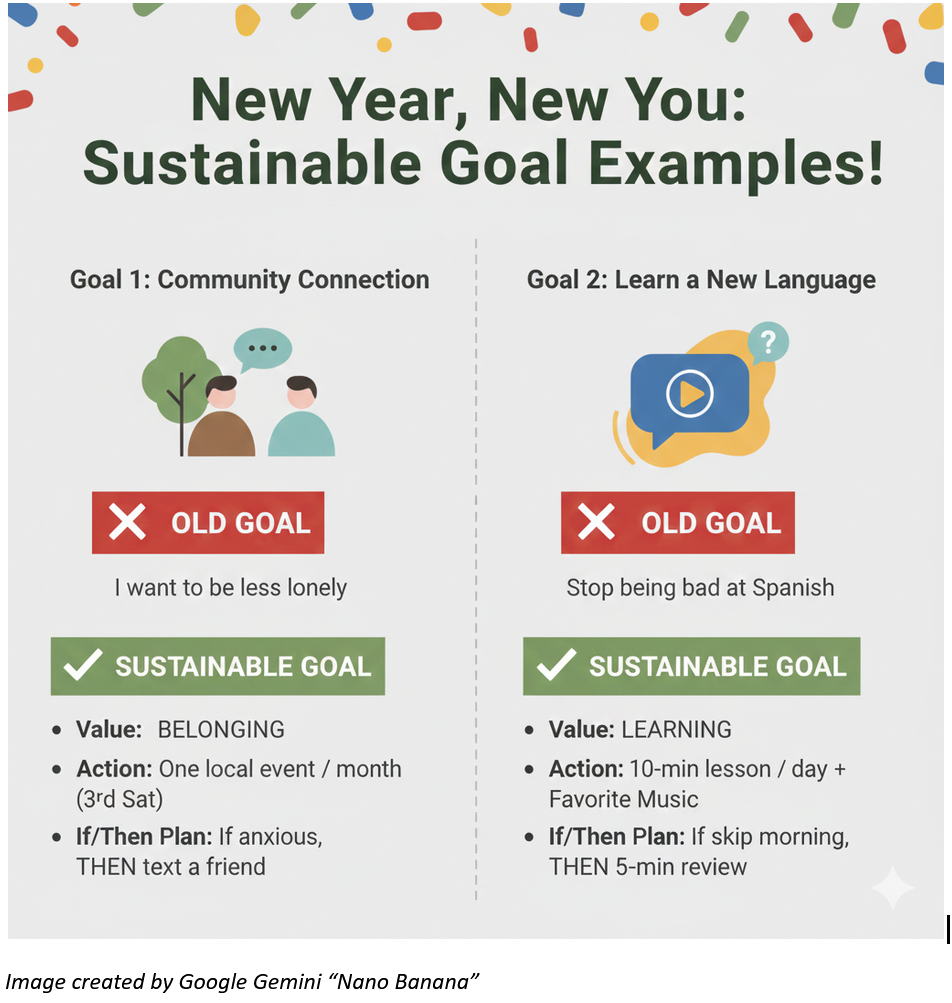
Sustainable goals have “implementation intentions” and action plans, including where, when, and how a goal will be implemented. Evidence suggests creating an “if/then” or a coping plan is important for goal setting (Bailey, 2024). Some days you may not be motivated to engage in your goal, or other life commitments can get in the way. Make a gameplan for motivational or logistical barriers.
- If you’re noticing difficulty feeling motivated, try “temptation bundling,” or pairing your goal with something you do enjoy (Milkman, Minson, & Volpp, 2015). For example, call a friend while you go for a walk. Or see if you can do 10 minutes worth of the goal.
- Implement “if/then” logic: If [Situation X] happens, then I will [Response Y].
Does your goal involve a mechanism to track progress?
Track what you do. Visualization is critical, as getting feedback and tracking your progress are catalysts for hitting your goals (Locke & Latham, 2006).
Write out, color in, or mark, each time you complete your goal. Keeping it in a place you see often (bathroom mirror, office desk, front of refrigerator) is important.
By shifting to these evidence-based, sustainable goals, you aren't just planning for a better January, you're building a foundation for a values-aligned 2026. Happy goal setting!
The opinions in CDP Staff Perspective blogs are solely those of the author and do not necessarily reflect the opinion of the Uniformed Services University of the Health Science or the Department of Defense.
Alessandra Grillo, Ph.D., is a Postdoctoral Fellow at the Center for Deployment Psychology. Dr. Grillo earned her doctoral degree in Clinical Psychology from the University of North Carolina at Greensboro and completed her pre-doctoral internship at the Boston VA Healthcare System where she provided brief and full-model evidence-based treatments for a wide range of mental and physical health concerns in primary care and outpatient clinics serving Veterans.
References:
Bailey R. R. (2017). Goal Setting and Action Planning for Health Behavior Change. American journal of lifestyle medicine, 13(6), 615–618. https://doi.org/10.1177/1559827617729634
Buehler, R., Griffin, D., & Peetz, J. (2010). The planning fallacy: Cognitive, motivational, and social origins. In Advances in experimental social psychology (Vol. 43, pp. 1-62). Academic Press.
Elliot, A. J. (2013). Handbook of approach and avoidance motivation. Psychology Press.
Gracia, S. (2024, January). New Year’s resolutions: Who makes them and why. Pew Research Center. https://www.pewresearch.org/short-reads/2024/01/29/new-years-resolutions-who-makes-them-and-why/
Hayes, S. C., Strosahl, K. D., & Wilson, K. G. (1999). Acceptance and Commitment Therapy: An experiential approach to behavior change. Guilford Press.
Kahneman, D., & Tversky, A. (1979). Intuitive prediction: biases and corrective procedures. TIMS Studies in Management Science, 12, 313–327
Locke, E. A., & Latham, G. P. (2006). New Directions in Goal-Setting Theory. Current Directions in Psychological Science, 15(5), 265–268. https://doi.org/10.1111/j.1467-8721.2006.00449.x
Oscarsson M, Carlbring P, Andersson G, Rozental A (2020) A large-scale experiment on New Year’s resolutions: Approach-oriented goals are more successful than avoidance-oriented goals. PLoS ONE 15(12): e0234097. https://doi.org/10.1371/journal.pone.0234097
Milkman, K. L., Minson, J. A., & Volpp, K. G. (2014). Holding the Hunger Games Hostage at the Gym: An Evaluation of Temptation Bundling. Management science, 60(2), 283–299. https://doi.org/10.1287/mnsc.2013.1784
Sheldon, K. M., & Elliot, A. J. (1999). Goal striving, need satisfaction, and longitudinal well-being: The self-concordance model. Journal of Personality and Social Psychology, 76(3), 482–497.
Strava (2025, December 31). Conquer Quitter’s Day Challenge. Strava. https://www.strava.com/challenges/5560


The year 2026 is upon us. As we usher in a New Year, for many, this is the opportunity to set a new goal, intention, or resolution. Did you set a New Year’s resolution? If so, statistically speaking, you’re not alone. A recent study by the Pew Research Center found one in three adults made at least one resolution, and over half of this group made more than one goal. Paradoxically, roughly 41% of those adults abandoned at least one goal (or all of them) by the end of the month (Garcia, 2024). In fact, a popular social platform for fitness (Strava) dubbed the second Friday of January as “Quitters’ Day,” based on site data suggesting that fitness-related resolutions or goals are statistically most likely to be abandoned then (Strava, 2025). .
These trends raise an important question: what distinguishes a sustainable goal? While the specific behavior of goal setting around the New Year is surprisingly understudied, we can look to literature on motivation and behavior change to create evidence-based, sustainable goals. As you design your New Year’s resolution, consider the following questions:
Is your goal “Approach” or “Avoidance” oriented?
Motivational and social psychology often categorizes goals in two buckets: “approach” goals, that is, moving toward positive goals, rewards, or desired outcomes, versus “avoidance” goals, which is moving away from negative, undesirable outcomes including threats or punishments (Elliot, 2013). People who set “approach-oriented” goals (regardless of the goal type) are statistically more likely to complete them versus avoidance-oriented goals (Oscarsson, Carlbring, Andersson, & Rozental, 2020).
For example, a goal of “I am going to engage in 10 minutes of mindfulness each morning” is different from “I am not going to get stressed” because separate cognitive and emotional processes are at play. Approach-oriented goals are associated with greater positive affect and psychological well-being, while avoidance-oriented goals induce negative emotions and can activate fear circuits (Bailey, 2017).
Does your goal connect to your “Why?”: Values-aligned goals
Both theory and research show that goals aligned with our personal values are more likely to be completed (Sheldon & Elliot, 1999). When establishing a goal, it is useful to reflect on your underlying motivation: what is your “why?” How will achieving this goal add meaningfully to your life? Distinguishing between goals driven by intrinsic motivation (e.g., your “inner drive”) versus perceived obligations (e.g., what others think you “should” do) can be helpful.
Recalibrate your why: A brief values clarification exercise, such as a values card-sorting task grounded in principles of Acceptance and Commitment Therapy (ACT; Hayes, Strosahl, & Wilson, 1999), may help identify core values and guide goal selection.
Is your goal balanced in its level of difficulty?
Sustainable goals strike a balance of difficulty and attainability. Evidence from organizational psychology shows that goals that are perceived as optimally challenging are more likely to be achieved relative to goals that are “too easy” and require less effort by comparison (Locke & Latham, 2006). This is often termed the “Goldilocks” principle, because goals that are “just right” in their ability to challenge you can induce feelings of confidence and self-efficacy, which are important for completing your goals (Bailey, 2017).

Are you willing to be flexible in your goal?
Sustainable goals are not rigid, they are naturally adjustable. Humans also have a tendency to overestimate our goals or “bite off more than we can reasonably chew”, known as the planning fallacy (Kahneman & Tversky, 1979). The planning fallacy is based on the principle that people tend to underestimate the time it will take to complete a goal (Buehler, Griffin, and Peetz, 2010). Thus, in addition to daily or weekly tracking of your goal, consider quarterly check-ins, and be willing to adjust as needed to make it more likely to complete your goal.
Does your goal have an “action plan” for both implementation and setbacks?
Sustainable goals have “implementation intentions” and action plans, including where, when, and how a goal will be implemented. Evidence suggests creating an “if/then” or a coping plan is important for goal setting (Bailey, 2024). Some days you may not be motivated to engage in your goal, or other life commitments can get in the way. Make a gameplan for motivational or logistical barriers.
- If you’re noticing difficulty feeling motivated, try “temptation bundling,” or pairing your goal with something you do enjoy (Milkman, Minson, & Volpp, 2015). For example, call a friend while you go for a walk. Or see if you can do 10 minutes worth of the goal.
- Implement “if/then” logic: If [Situation X] happens, then I will [Response Y].
Does your goal involve a mechanism to track progress?
Track what you do. Visualization is critical, as getting feedback and tracking your progress are catalysts for hitting your goals (Locke & Latham, 2006).
Write out, color in, or mark, each time you complete your goal. Keeping it in a place you see often (bathroom mirror, office desk, front of refrigerator) is important.
By shifting to these evidence-based, sustainable goals, you aren't just planning for a better January, you're building a foundation for a values-aligned 2026. Happy goal setting!
The opinions in CDP Staff Perspective blogs are solely those of the author and do not necessarily reflect the opinion of the Uniformed Services University of the Health Science or the Department of Defense.
Alessandra Grillo, Ph.D., is a Postdoctoral Fellow at the Center for Deployment Psychology. Dr. Grillo earned her doctoral degree in Clinical Psychology from the University of North Carolina at Greensboro and completed her pre-doctoral internship at the Boston VA Healthcare System where she provided brief and full-model evidence-based treatments for a wide range of mental and physical health concerns in primary care and outpatient clinics serving Veterans.
References:
Bailey R. R. (2017). Goal Setting and Action Planning for Health Behavior Change. American journal of lifestyle medicine, 13(6), 615–618. https://doi.org/10.1177/1559827617729634
Buehler, R., Griffin, D., & Peetz, J. (2010). The planning fallacy: Cognitive, motivational, and social origins. In Advances in experimental social psychology (Vol. 43, pp. 1-62). Academic Press.
Elliot, A. J. (2013). Handbook of approach and avoidance motivation. Psychology Press.
Gracia, S. (2024, January). New Year’s resolutions: Who makes them and why. Pew Research Center. https://www.pewresearch.org/short-reads/2024/01/29/new-years-resolutions-who-makes-them-and-why/
Hayes, S. C., Strosahl, K. D., & Wilson, K. G. (1999). Acceptance and Commitment Therapy: An experiential approach to behavior change. Guilford Press.
Kahneman, D., & Tversky, A. (1979). Intuitive prediction: biases and corrective procedures. TIMS Studies in Management Science, 12, 313–327
Locke, E. A., & Latham, G. P. (2006). New Directions in Goal-Setting Theory. Current Directions in Psychological Science, 15(5), 265–268. https://doi.org/10.1111/j.1467-8721.2006.00449.x
Oscarsson M, Carlbring P, Andersson G, Rozental A (2020) A large-scale experiment on New Year’s resolutions: Approach-oriented goals are more successful than avoidance-oriented goals. PLoS ONE 15(12): e0234097. https://doi.org/10.1371/journal.pone.0234097
Milkman, K. L., Minson, J. A., & Volpp, K. G. (2014). Holding the Hunger Games Hostage at the Gym: An Evaluation of Temptation Bundling. Management science, 60(2), 283–299. https://doi.org/10.1287/mnsc.2013.1784
Sheldon, K. M., & Elliot, A. J. (1999). Goal striving, need satisfaction, and longitudinal well-being: The self-concordance model. Journal of Personality and Social Psychology, 76(3), 482–497.
Strava (2025, December 31). Conquer Quitter’s Day Challenge. Strava. https://www.strava.com/challenges/5560