
Staff Perspective: In Memory of Dr. Edna Foa
I “knew” Edna Foa before I met Edna Foa, as one does when the person you are talking about is as renowned, as scholarly, as influential in one’s field of study as she was and will remain even after her passing. Her work, of course, is foundational in understanding the impact of trauma and in the treatment of PTSD, but she is equally respected as an international expert in OCD. She developed the most efficacious treatments for both PTSD and OCD, and continued to refine our understanding of these disorders and their treatment throughout her life. At the same time, she worked to make evidence-based treatment more widely available by leading initiatives to disseminate treatment across the globe.
I have read many obituaries and tributes to her since I learned of her passing, and they all speak of her scientific rigor, her intellectual brilliance, and her commitment to alleviating suffering. They speak of her tireless work ethic and her relentless pursuit of more: more knowledge, more understanding, more effectiveness, greater impact. That impact is not only evident in the hundreds of published articles, numerous books, and over 10 million dollars in grants, but in the power of her mentorship, and truly, she was a mentor to many of the current luminaries in the study of anxiety, PTSD, and OCD. Even so these tributes do not fully describe the tremendous impact of her legacy.
I finally met her for real when I interviewed for a position at the Center for the Treatment and Study of Anxiety. I was to be a clinician in many of the studies of Prolonged Exposure Therapy. To my profound surprise and delight, I was hired, and began one of the most demanding and richly rewarding experiences of my professional career. She was a brilliant researcher, an insightful and compassionate clinician, and an inspiring leader. In my time at CTSA she consulted on nearly every case from her large faculty of clinicians and researchers. Her consultation was direct and unrestrained. When errors occurred, she provided precise feedback on their nature and causes. Her approval was equally discerning, and was prized, though less frequent.
Beyond her groundbreaking work, her personal passions revealed a vibrant side that enriched those around her. As I came to know her personally, I learned that she also loved the symphony and collected art. She was a curious and penetrating conversationalist and did not shy away from controversial topics. She was interested in fashion, but not “high” fashion. Her style was unique, sometimes eccentric (her word, not mine) in her signature black with splashes of color and the ubiquitous cape or shawl that could be dramatically tossed over the shoulder. She and her late husband Charles loved to gather her CTSA family at her home several times a year for dinner or a picnic, and she delighted in hosting the international groups who came to CTSA to train several times a year. She was creative as well. I learned she designed most of her unique dresses and had them made in Israel on her many visits. She was also a knitter; a fact I discovered when she saw me knitting and offered to teach me a new technique!
In my mind, she is always busy. Busy writing, creating, going to the symphony, traveling, teaching, learning something new, telling someone else about it… I miss her already, even though we weren’t in frequent contact. I still hear her voice when I teach or write, admonishing, encouraging me to get it exactly right. I feel her absence knowing that we won’t meet at a conference or share an email any longer. I am profoundly grateful for her mentorship and teaching, and for her friendship. May her memory be a blessing to all who knew her and to those who feel connected to her through her work and her legacy.
The opinions in CDP Staff Perspective blogs are solely those of the author and do not necessarily reflect the opinion of the Uniformed Services University of the Health Science or the Department of Defense.
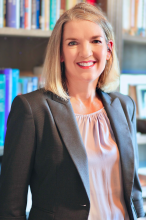
Kelly Chrestman, Ph.D., is a Senior Military Behavioral Health Psychologist at the Center for Deployment Psychology (CDP). She provides training, support and consultation in Cognitive Behavioral Therapy and in the Assessment and Treatment of PTSD.


I “knew” Edna Foa before I met Edna Foa, as one does when the person you are talking about is as renowned, as scholarly, as influential in one’s field of study as she was and will remain even after her passing. Her work, of course, is foundational in understanding the impact of trauma and in the treatment of PTSD, but she is equally respected as an international expert in OCD. She developed the most efficacious treatments for both PTSD and OCD, and continued to refine our understanding of these disorders and their treatment throughout her life. At the same time, she worked to make evidence-based treatment more widely available by leading initiatives to disseminate treatment across the globe.
I have read many obituaries and tributes to her since I learned of her passing, and they all speak of her scientific rigor, her intellectual brilliance, and her commitment to alleviating suffering. They speak of her tireless work ethic and her relentless pursuit of more: more knowledge, more understanding, more effectiveness, greater impact. That impact is not only evident in the hundreds of published articles, numerous books, and over 10 million dollars in grants, but in the power of her mentorship, and truly, she was a mentor to many of the current luminaries in the study of anxiety, PTSD, and OCD. Even so these tributes do not fully describe the tremendous impact of her legacy.
I finally met her for real when I interviewed for a position at the Center for the Treatment and Study of Anxiety. I was to be a clinician in many of the studies of Prolonged Exposure Therapy. To my profound surprise and delight, I was hired, and began one of the most demanding and richly rewarding experiences of my professional career. She was a brilliant researcher, an insightful and compassionate clinician, and an inspiring leader. In my time at CTSA she consulted on nearly every case from her large faculty of clinicians and researchers. Her consultation was direct and unrestrained. When errors occurred, she provided precise feedback on their nature and causes. Her approval was equally discerning, and was prized, though less frequent.
Beyond her groundbreaking work, her personal passions revealed a vibrant side that enriched those around her. As I came to know her personally, I learned that she also loved the symphony and collected art. She was a curious and penetrating conversationalist and did not shy away from controversial topics. She was interested in fashion, but not “high” fashion. Her style was unique, sometimes eccentric (her word, not mine) in her signature black with splashes of color and the ubiquitous cape or shawl that could be dramatically tossed over the shoulder. She and her late husband Charles loved to gather her CTSA family at her home several times a year for dinner or a picnic, and she delighted in hosting the international groups who came to CTSA to train several times a year. She was creative as well. I learned she designed most of her unique dresses and had them made in Israel on her many visits. She was also a knitter; a fact I discovered when she saw me knitting and offered to teach me a new technique!
In my mind, she is always busy. Busy writing, creating, going to the symphony, traveling, teaching, learning something new, telling someone else about it… I miss her already, even though we weren’t in frequent contact. I still hear her voice when I teach or write, admonishing, encouraging me to get it exactly right. I feel her absence knowing that we won’t meet at a conference or share an email any longer. I am profoundly grateful for her mentorship and teaching, and for her friendship. May her memory be a blessing to all who knew her and to those who feel connected to her through her work and her legacy.
The opinions in CDP Staff Perspective blogs are solely those of the author and do not necessarily reflect the opinion of the Uniformed Services University of the Health Science or the Department of Defense.
Kelly Chrestman, Ph.D., is a Senior Military Behavioral Health Psychologist at the Center for Deployment Psychology (CDP). She provides training, support and consultation in Cognitive Behavioral Therapy and in the Assessment and Treatment of PTSD.